0

SEND awareness - Blog - CPD Learning & Professional Development Tips at Laser Short Courses: SEND awareness
SEND awareness
Tuesday 18th February, 2025

Special Educational Needs and Disabilities, also known as SEND, refers to a range of different conditions affecting children and young people that may result in them requiring additional support to learn and develop. You will often hear the acronym SEND used in educational and care settings as a reference to the SEND system of support offered to children and young people aged 0-25 years. You may also be aware of the ‘SEND Code of Practice’ that provides advice and statutory guidance for how best to identify and support children and young people in settings that care for, teach, and support them.
But, what conditions are actually categorised as SEND in this country? Any medical condition that affects a child’s ability to learn would be considered SEND. Specifically, any condition that affects a child’s:
• Behaviour and mental health, such as Obsessive Compulsive Disorder (OCD)
• Communication and ability to socialise, such as Autism Spectrum Condition (ASC)
• Reading and writing, such as Dyslexia
• Sensory impairment, such as partial sight loss
• Cognition and learning, such as Down Syndrome
• Concentration levels, such as Attention Deficit Hyperactivity Disorder (ADHD)
• Physical ability, such as Dyspraxia
SEND can also affect a child’s ability to access facilities, public spaces, and the curriculum.
A children with SEND may experience mild to moderate impact on their health, wellbeing, and ability to learn, or it may be more severe. Needs may also change over time, and some children may need more or less support than others. The most important thing to remember is every child is unique, and has unique support needs.
SEND covers a broad and diverse range of needs, and it is important to note that a child with a condition categorised as SEND can still thrive and achieve in education and in later life. We need to make sure they are well supported and remove barriers to learning to give these children and young people the best chance of positive outcomes.
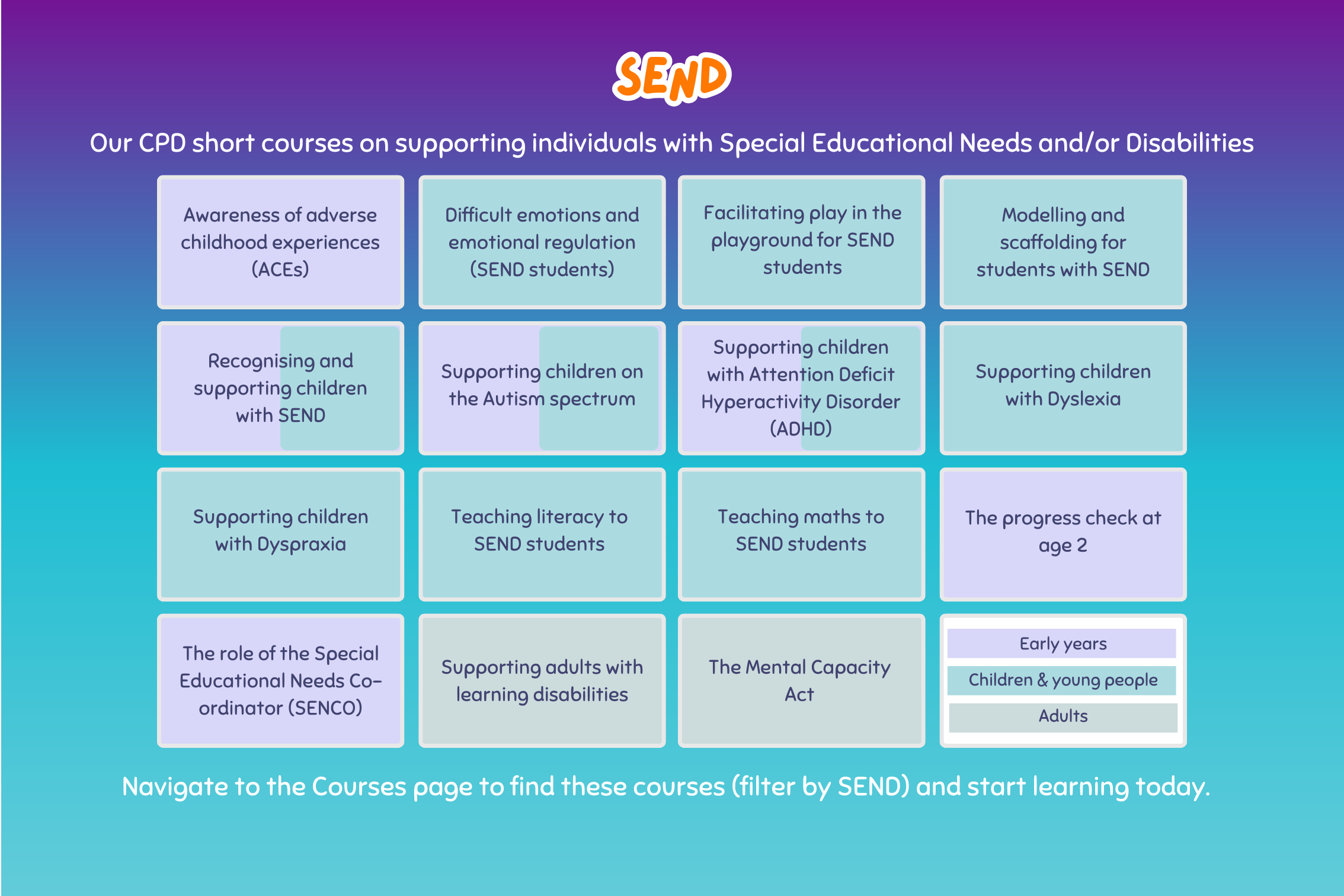
If you would like to learn more about supporting individuals with SEND, Laser Short Courses has a number of excellent courses on the topic.